The world is running out of names – and Big Tech’s showing off about it
Ever had a brilliant idea for a business name? What was it?
I’ve got one for an app that combines fitness and mindfulness: Temple. Inspired by ‘my body is a temple’ for the fitness element, as well as the ‘temple of your mind’ and religious mindfulness teachings for the mental wellness side.
Just need to check that on a trademark database…
167 clashes worldwide, and 18 Temple’s in the UK and US alone. I haven’t even searched for alternative spellings or phonetically similar names yet – but safe to say, Temple is dead in the water.
It feels like the world is running out of (trademark-able) one-word names from the English language. When Apple first trademarked its name, the year was 1977 and trademarks were ripe for picking. As I write this article, there are 145 global trademarks for even the more niche fruit, ‘Papaya’. It isn’t only one-word names either, neat compound or derivative names – think Spotify or Moju (‘more juice’) juice shots – are becoming increasingly hard to trademark too.
So how come, just as the Metaverse was beginning to boom in 2021, Facebook managed to trademark ‘Meta’? Easy: it shelled out $60million to buy it off everyone else. And it’s not the only big business to use a new one-word name as a symbol of power.
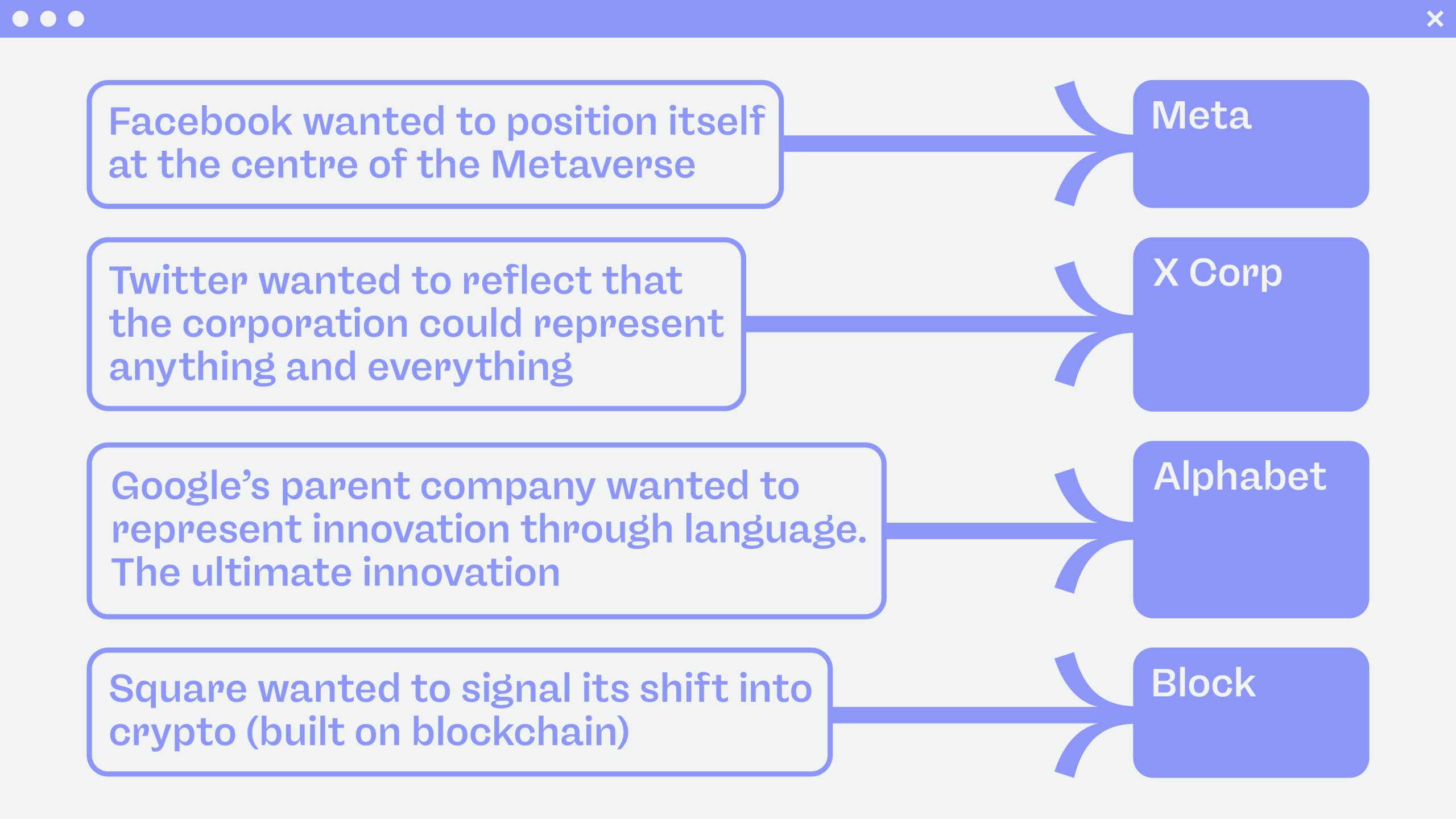
Big tech is the ruling class of the internet. Despite the trademark drought the rest of the naming industry is struggling with, each of these global leaders has transcended the normal limits of power and money that other brands have to adhere to, to pick the cream of the naming crop.
Should we all be trying to follow suit? No – and yes. No, because even ‘X’ (X Corp) is in ongoing legal battles trying to trademark a single-letter name. Yes, because what each brand is really doing is telling a clear story about who it is – both through the meaning of the name it chose and the power it wields in securing it.

Some companies create and choose names based on trademark availability. Others see their name as an opportunity to tell their story.
Take Kallikor. It’s a business that uses AI modelling to create synthetic worlds that mirror the ones its clients operate in. By helping businesses predict and prepare for future scenarios, Kallikor helps them leap forward and grow. To tell that story, we built its brand from the ground up – including the name. Kallikor comes from Callicore, a genus of butterfly and as such represents mirroring and transformation. It's a phonetic replica of Callicore - but is designed to reflect an evolved modern interpretation of the Latinate original. Here, the name is a succinct symbol of not only what Kallikor is, but its vision for the future.

One-word names are harder than ever to trademark, and even the Spotifys and Mojus of the world are becoming scarce. But one resource that won’t run out (and Big Tech can’t monopolise) is originality. There are always new stories to discover, as well as brilliant ideas that package up an entire concept in a single wordmark. And to answer my earlier question, I think it’s much more inspiring (and ownable) to be named Google, than Block.