
Beyond lip service
Why brand matters in customer service (and why so few get it right)
The customer is always writing
We’ve all been there: a brand you just bought from has let you down and you’re bashing out a strongly worded complaint to its customer service team. Being forced to spend the time and effort to chase up a company for a problem that isn’t your fault can be more than a little irritating. It becomes downright infuriating when the response you get totally misses the mark.
Often, when the reply finally hits your inbox, you’re met with a generic, robotic response. It’s got none of the charm that you’ve come to expect from the brand. None of the wit and humour that made you follow their Instagram account. And none of the thought, warmth and personality that probably got you to buy from them in the first place. If there had been, you’d probably be more forgiving.
Making every connection count
There’s a reason we feel let down. People form emotional connections to brands, not products or services. It goes beyond simple customer satisfaction – building emotional resonance in your brand drives value. It’s why brands, good ones at least, spend significant time, money and effort building emotion into how their brands look, feel and sound. Which begs the question… why do so many brands pull the emotional rug from under our feet at exactly the time when we are likely to be most upset, or in need of empathy or understanding – as we are when dealing with customer service?
According to Forbes, “96% of customers say customer service is important in their choice of loyalty to a brand.” How well their problems are solved is key, but the overall experience shouldn’t be underestimated either. To quote customer service expert Shep Hyken, “a good experience creates a positive memory… and when the customer comes back a second time and a third time and has similar experiences, the memories of those interactions become an owned experience. The customer expects it. They know it’s going to happen, just like last time.” That experience is built on brand, and, good or bad, it compounds the emotional impression we’re left with.
You’d think businesses would be scrambling to make sure their brand permeated every point of the customer experience. Especially those that have taken so much time to build a brand people love. Brands are ready to throw their voice around at headline level (billboards, ads, the top of their homepage) only for it to disappear completely in less prominent but important areas like product descriptions, email marketing, and yes, customer service. Consistency is key, but all too often lacking.
Nailing it
Take Liquid Death, for example. In a world of Aquafinas, Evians, Essentials and Fijis, Liquid Death did something scarily different. People told founder Mike Cessario that his can designs looked too much like beer, that customers would find it confusing and retailers would sooner die than put a product that said ‘death’ on their shelves. They were wrong. Today, Evian has 177k followers on Instagram and no presence on TikTok other than the account for its cosmetic face spray. Liquid Death has 7.5 million Instagram followers and another 7 million on TikTok. The benefits of creating such a distinctive and emotionally resonant (albeit acquired tasting) brand are plain to see.
Part of what makes Liquid Death’s brand so successful is a commitment to rolling out its identity and tone of voice consistently across different channels. Where so many brands drop the ball at their newsletter, Liquid Death continues to nail it, serving up the deadpan humour that people know and love about its tone of voice.
Thirsty for more
We wanted to put the brand to the customer service test. Does Liquid Death really live up to the high standards it has set for itself, particularly when it comes to customer service?
When you sign up for the newsletter, you’re given a discount code for free paper bag coolers. One of our writers, Eva, signed up, but forgot to use the discount code on checkout, and was charged £9 for her free items. Instead of panicking, she emailed their customer service team asking for help. Could a refund be applied? Being a die-hard Liquid Death fan – and a brand writer – she also took the opportunity to write to them in their own tone of voice.
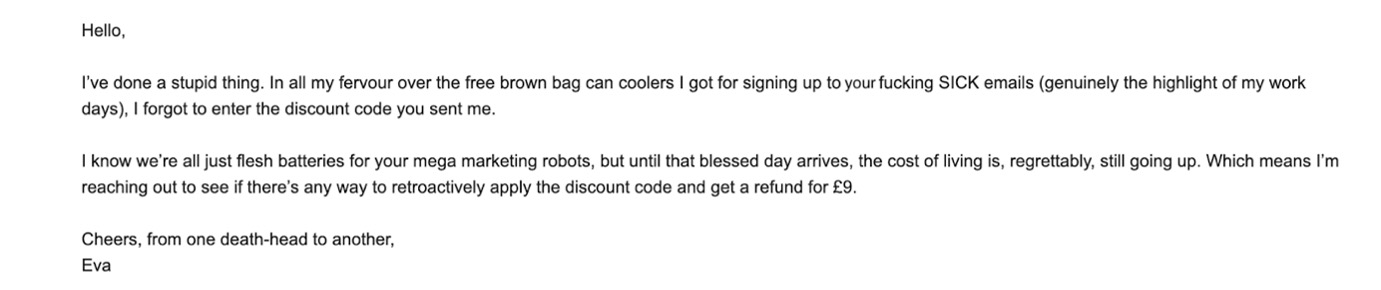
The response was underwhelming, with a customer service communication that sounded nothing like the brand that Eva loves. The fact that she’d taken the time and effort to write in their voice should have made getting the response on brand a simple task. Granted, it was probably a template, but those can and should be on brand, unless they’re responding to someone who is angry and needs something more personal and considered.
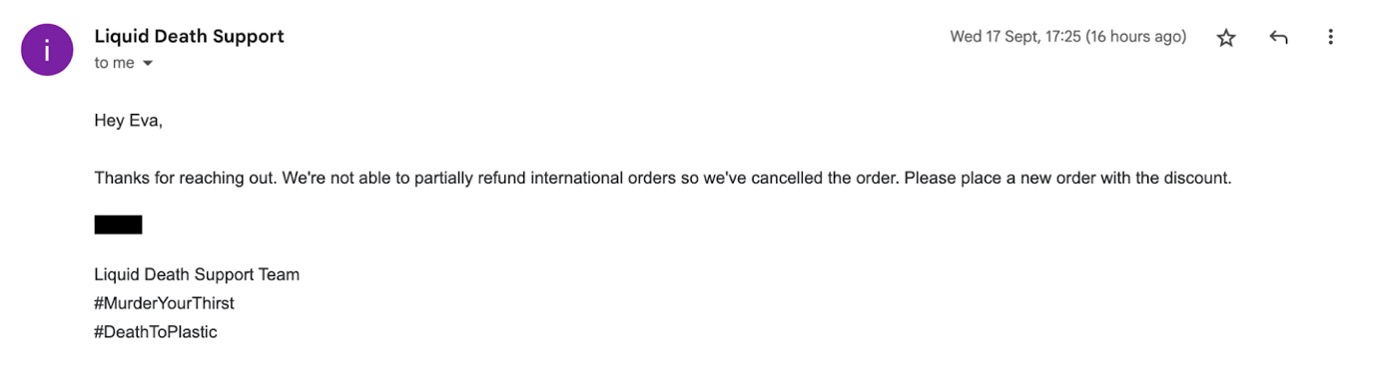
While the customer service team solved the problem – cancelling the order and allowing Eva to put in a new one with the discount code added – the experience points to a big, missed opportunity for the brand. Liquid Death has put so much effort into getting its tone of voice spot on, so why not use it to its full effect when having a direct conversation with one of its loyal customers?
The fact is, most brands’ tone of voice falls apart at the customer service level. There are plenty of reasons for it. Some brands just don’t have a good enough handle on their own identity to apply it consistently. Some believe voice has no place in functional moments. Most have time-poor teams and unwieldy guidelines that either don’t do a great job explaining tone of voice (if they touch on it at all) – or simply don’t cover CS-related content. Those aren’t mutually exclusive. It’s often a combination of all three.
Toning Up
Here at The Clearing, we’ve built a solution. It’s called Tonable and it’s an AI-powered writing coach that helps teams own their tone of voice. Copywriters, don’t worry - it’s not a replacement for any of us. In fact, Tonable needs comprehensive voice guidance in order to learn the way a brand speaks. And it’s a walled environment, so no random LLM is going to steal your work.
Tonable lets people check their text against their brand’s tone of voice principles. It tells them what they’re doing well and what they need to work on, and gives clear, actionable advice for improvement. It can rewrite content for anyone who’s low on time, but its primary purpose is teaching people to use their brand’s tone of voice consistently.
If that sounds like something your team could use (or if you’re guilty of letting brand slip when it comes to customer service), drop us a line or read more about how Tonable works here.